Controversy and chaos trail whatever Trump touches. For 32 years, the Commission on Presidential Debates, a bipartisan organization, made the United States Presidential Debates the toast of the world. Through the Commission, the US exported presidential debates to more than forty democracies around the world. US Presidential Debates became one of America’s soft powers, and the Commission ensured that, unlike in previous election cycles before the birth of the Commission, presidential debates remained a permanent feature of presidential elections. Then Trump happened, and the bipartisan organization was accused of partisanship. After eight years of chipping away at the Commission’s foundation and calls to question its integrity, the Commission folded under the Trump tempest. In 2024, for the first time in more than three decades, private media organizations CNN and ABC handled the presidential debates. What happened to the Commission on Presidential Debates mirrors the fate of many democratic institutions in the US since 2016; bruised, battered, and bowed.
In 2016, as Trump swept through the doors of US politics, upending traditions and democratic culture, the Fédération Internationale de Football Association (FIFA) was trying to sanitize its house after sweeping allegations of corruption that involved its former president, Sepp Blatter, and former Union of European Football Association (UEFA) president Michel Platini (both were eventually cleared of the allegations). In Gianni Infantino, then general secretary of UEFA, FIFA believed it had found a clean, self-effacing persona to restore the credibility of global football. After his election, Infantino made the right statements: “I will work tirelessly to bring football back to FIFA, and FIFA back to football.” Infantino kept his promise and worked hard to turn around the fortunes of FIFA. From a cesspit that swallowed $550 million and caused sponsors to turn their backs, he restored trust and financial health to the organization. “It’s your money, not the money of the FIFA president,” Infantino told FIFA delegates in 2016.
FIFA delegates like English Football Association chairman Greg Dyke, who supported Infantino, say he is “not a politician and has no ego.” That was before Infantino got in the saddle. Since 2016, the FIFA president has evolved gradually from the unassuming, assiduous technocrat into a brash, assertive wheeler-dealer, staking his claim to a large dose of klieg lights. Real money and power make a potent mixture capable of loosening the tongue and pumping the ego of the most modest of mortals. It was not long before Infantino started firing loose cannons. After calling Western countries hypocrites for criticizing the award of the 2022 World Cup tournament to Qatar over allegations of human rights violations, Infantino said it was a surprise that no English fan was arrested during the football fiesta. According to the world football-governing body boss: “English fans just go and riot around the world and at football matches.” He later apologized, belatedly. Also, the once unobtrusive figure in UEFA has been soaking up media attention and demanding more. At the Qatar World Cup, Infantino reportedly asked directors of media organizations covering the event to ensure he was captured once every game, but absent when he is on the phone. As he creatively expanded FIFA’s poster event, the World Cup, so his basic wage rose by 33%, from £1.7 million in 2022 to £2.6 million in 2024. As his image grew too, so did his network of friends. Kings, presidents, and private jets welcomed him into their palatial surroundings. Infantino appears to be drawn to autocrats. He forged a close relationship with Russian President Vladimir Putin, who bestowed the Order of Friendship medal on the FIFA chief. In return, Infantino pushed for the return of Russia to global football, even as Putin continues to wage war against Ukraine. “This ban has not achieved anything and has just created more frustration and hatred. Having girls and boys from Russia being able to play football games in other parts of Europe would help.” How about Infantino leans on his bromance with Putin and convinces the Russian leader to stop the war that has killed thousands of Ukrainian boys and girls? For his insensitive and selfish suggestion, Ukraine’s sport minister Matvil Bidnyi labeled Infantino “Infantile,” and reminded the FIFA chief that Russia has killed more than 650 Ukrainian athletes, including more than 100 footballers, since the start of the war.
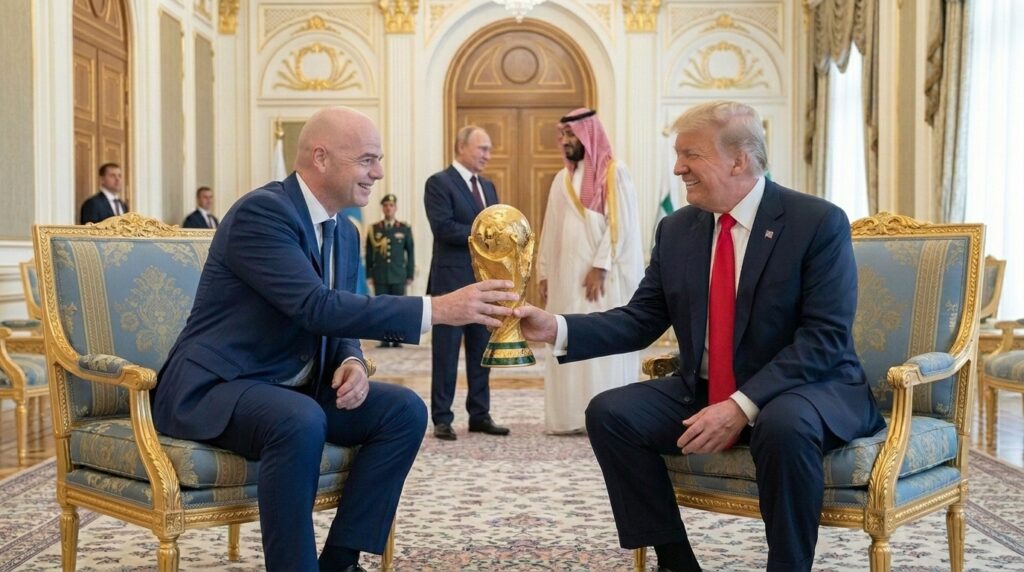
In global politics, one president, the President of the United States, Donald Trump, believes he towers above other presidents, and Infantino agrees. In May 2025, Infantino was a couple of hours’ late for a FIFA Congress, prioritizing a tour of the Middle East with Trump. UEFA delegates accused Infantino of placing private political interests above global football, and they expressed their disgust by staging a walkout. In July 2025, despite having a permanent office in Miami, FIFA acquired a new office in Trump Tower in New York. “FIFA is a global organization and to be global you have to be local, you have to be everywhere, so we have to be in New York,” Infantino reiterated. In December 2025, at the World Cup draw, Infantino awarded Trump the maiden FIFA Peace Prize intended for a person who has “taken exceptional and extraordinary actions for peace and united people across the world.” In his acceptance speech, Trump claimed he had saved millions of lives and stopped countless wars around the world through diplomatic intervention. Trump also reserved special praise for Infantino: “Gianni has done an incredible job.” However, football aficionados, fans around the world, including Football Supporters Europe, accused Infantino of exchanging football’s avowed political neutrality for personal favors from Trump. They maintained that the award does not reflect the wish of millions of football fans, and was merely an “ego-stroking stunt.”
The Kingdom of Saudi Arabia also received special attention from FIFA and Infantino. A fast-tracked process for awarding the 2034 World Cup hosting rights, which critics say lacked transparency, prevented the only potential opponent, Australia, from submitting a bid. FIFA published a glowing assessment of the credentials of the Saudis, rating the country 4.2 out of 5. It is the highest grade ever awarded by FIFA, and a medium risk score for human rights and low risk for environmental protection exposed the flawed parameters used. Aramco, the sprawling Saudi state-owned oil company, has since become a major sponsor of FIFA. Real money talks and unlocks access. Global football superstar Cristiano Ronaldo accompanied Saudi Crown Prince Mohammed bin Salman Al Saud to the White House, and succeeded in making Trump a side attraction in his own house. Afterwards, FIFA, unexpectedly and contrary to its own rules, pegged two of Ronaldo’s three-match suspension, effectively paving the way for the Portuguese captain to be available for Portugal’s opening match at the World Cup.
For UEFA and others who desire a rule-based order, Infantino’s erratic and irrational actions during the recently concluded World Cup across the US, Canada and Mexico proved too much to condone. When a FIFA-badged Somali referee, Omar Artan, was denied entry to the US to officiate in the World Cup, Infantino did not complain. “FIFA is not involved in host country immigration process,” was the short, evasive statement issued by the global football-ruling body, and when bemused journalists pressed Infantino to stand up for world football, he told them “Just, you know, chill, relax.” Iranian national team and Iraq striker, Aymen Hussein, also suffered discrimination from the host country, the US, but Infantino saw nothing amiss; instead, he told journalists the World Cup in the US would not have been possible without Trump’s support. UEFA would have none of it. Europe’s football-governing body compensated Artan by appointing him as referee for the Super Cup match between PSG and Aston Villa. The Confederation of African Football (CAF) was quiet, preferring to side with the money that Infantino guarantees instead of honor.
Then FIFA suspended Folarin Balogun’s red card to ensure his availability in the knockout match against Belgium (Youri Tielemans’-led team defeated the US 4-1). The suspension came after Trump called Infantino to “review the red card” and disparaged Brazilian Raphael Claus, the referee, as someone with a shaky past. For bending football rules to accommodate him, Trump praised Infantino as “a smart, tough man,” whose “stock has gone through the roof.” UEFA would rather Infantino be shown the door. Ironically, if Trump successfully repeals the 14th Amendment, as he intends, in the future, persons like Folarin Balogun, whom Trump described as “our best player,” would be ineligible to play for the US.
Then came the last straw for UEFA. Infantino and his friends hatched a lucrative commercial plan to sell shares in FIFA’s competitions, including the World Cup, to private investors. A payment of £30 million was guaranteed to each of FIFA’s 211 associations if they backed the plan. At the center of the deal is Thrive Capital, a company owned by Joshua Kushner, younger brother of Trump’s son-in-law, Jared Kushner. Also, Greg Maffei, former president of Formula 1, owner of Liberty Media, and financial donor to Trump campaigns, served as “commercial advisor” for the deal. As it turned out, FIFA executive members who should have known and approved the plan before making it public were in the dark. The uproar and condemnation that greeted the plan were overwhelming. UEFA, CONCACAF, the football governing body in Central America and the Caribbean, and the Asian Football Association (AFC) distanced themselves immediately from the plan. South America’s football governing body, CONMEBOL, requested additional information from FIFA. CAF and Oceania refused to take a stand until they had held meetings to discuss the vexatious matter.
As resistance to the plan grew, Infantino took the fight to critics, asking them to “mediate, pray, or watch a match instead of spreading hate and false rumors.” Then it emerged that Infantino’s plan was unknown to eight FIFA vice presidents. Infantino’s senior adviser on global strategy and governance, Carlos Cordeiro, resigned, insisting the plan was a “bad deal for football and would mortgage football’s future.” FIFA’s chief operating officer, Kevin Lamour, described the plan as “the project of one person,” and UK Prime Minister Andy Burnham stated that Infantino was the “wrong man to lead FIFA.” More condemnation followed, then Infantino folded under pressure and withdrew the plan. However, UEFA and others, like Portuguese and former Real Madrid star Luis Figo, are still calling for Infantino’s resignation, and they threatened to withdraw from FIFA-organized competitions if he refuses to go. Expectedly, CONMEBOL, CAF and Qatar have thrown their weight behind Infantino. CONMEBOL and CAF depend on FIFA’s subvention, while Qatar is an ally of Infantino. The lower a country’s ranking on Transparency International’s Corruption Perception Index, the more likely the football association would back Infantino.
Like Trump, if you want to know the meaning of what Infantino is saying these days, look for the antonyms. In 2018, Infantino said it is important that “politics should stay out of football and football should stay out of politics,” yet, from Saudi Arabia, Qatar, Moscow to Washington, Infantino has been mixing politics with football and often elevating politics above football. When critics complained, the world football boss said it is important that football is represented in meetings with world leaders on politics and economy. In 2023, Infantino said: “Without referees there is no football. We have to fight for referees against any sort of abuse and violence.” However, when a US official accused Somalian referee Artan of having links to terror organizations, and Trump questioned the integrity of Brazilian referee Raphael Claus, Infantino did nothing to protect the honor of the referees. “We should all support what Trump is doing in the US because I think it’s looking pretty good.” While Infantino is beholden to Trump, his Faustian bargain with the US president has damaged the credibility of football. Henceforth, Infantino must keep world football away from White House politics and turn his attention towards regaining the confidence of UEFA delegates and all those who cherish the return of a transparent, rule-governed FIFA.