Consider for a second where Germany would have been without its infamous role in WW1 and WW2! Germany would probably be a permanent member of the United Nation’s Security Council, and certainly a nuclear-armed world power. Fission, the principle process that makes nuclear weapons possible was discovered in Berlin in December 1938 and America profited from Hitler’s hostility towards Jews as scientists who promoted US’ nuclear program arrived from Europe as immigrants. The misadventure of two German leaders, Kaiser Wilhelm 11 and Adolf Hitler truncated Germany’s steady economic and military growth at a critical time in the history of modern states.
The trajectories of nations are determined by the visions, decisions, sacrifices and works of men and women who lead. The deft and pragmatic leadership of President Adams steered a young and ideologically divided America through the Quasi-War of 1798-1800. As US’ merchant vessels were trapped on the sea between two great powers, Britain and France, the Republicans and Federalists closed ranks to defend the honor and interest of America. Yet they had to choose their battles carefully, wisely preferring to engage French privateers and grant concessions to the unassailable Royal British Navy. It was a masterstroke that preserved America as it grew its commerce and military might.
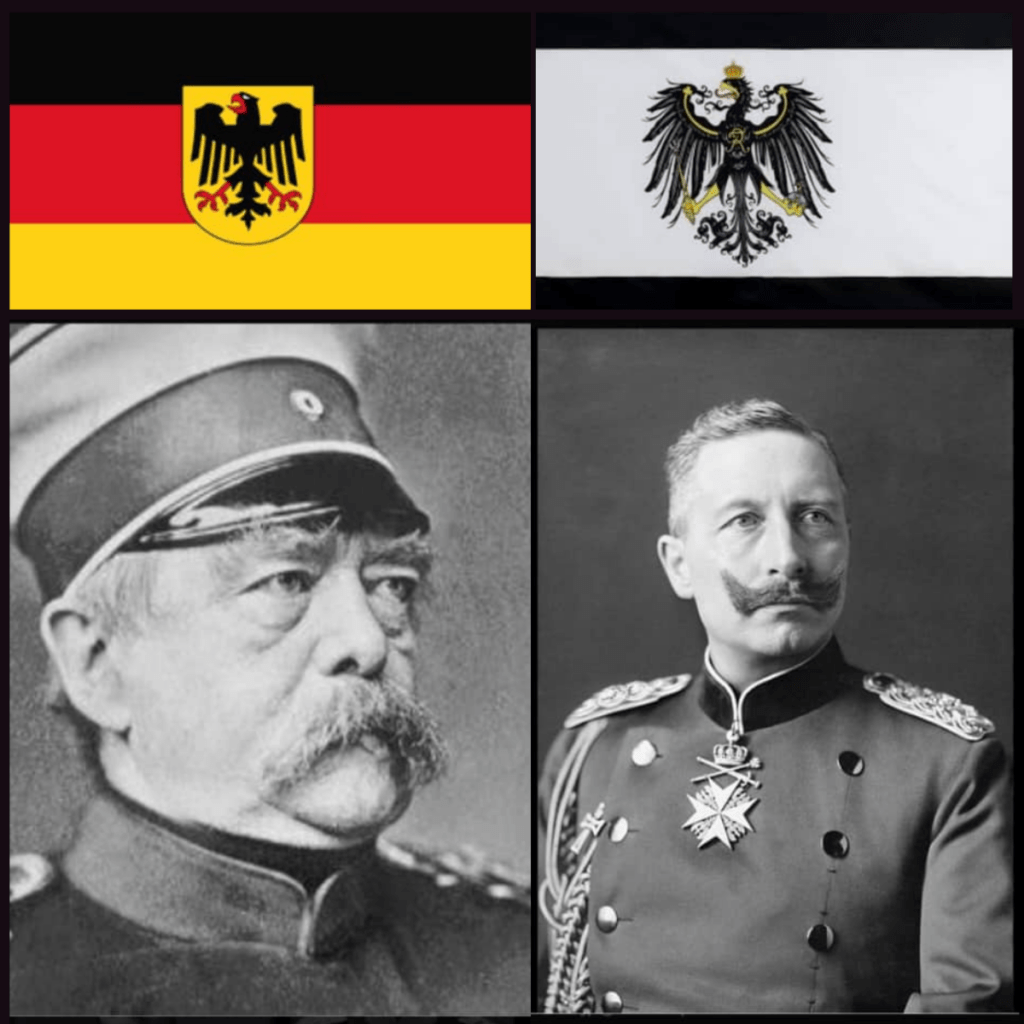
Fast forward to the 19th century, Germany was a respectable global power knit together by the “Iron Chancellor” Otto von Bismarck. But young and impulsive Kaiser Wilhelm 11 was eager for Germany to claim its “spot under the sun,” so he pushed aside and dispensed with the services of Bismarck, the glue that held the different nations and interests in Germany together. Bismarck gained valuable foreign policy experience representing Germany in Russia and France; this experience he brought to bear on resolving seemingly intractable internal and foreign issues such as the problems tabled at the infamous Berlin Conference. Without the guidance of the sage, Kaiser Wilhelm 11 stumbled from one blunder to another in the 20th century.
Prompted by a life-long animosity towards Britain, and nudged by his hawkish generals, particularly his chief admiral Alfred von Tirpitz, Kaiser Wilhelm 11 condemned Germany to enter a naval arms race with the indomitable Royal British Navy. Kaiser Wilhelm’s aim was to snatch a chunk of the sea trade and colonial territories from Britain, but the timing was premature and his decision unwise as it caused financial hardship for his government. Where President Adam of America stooped to conquer, Kaiser Wilhelm 11 choose frontal confrontation against an all-conquering foe. Germany lost the “Dreadnought arms race.”
The naval arms race; unholy alliances; the Daily Telegraph affair of 1908 – “You English are mad, mad, mad as March hares;” inexperience with international affairs; and inability to assert himself against his hawkish generals; contributed to set Germany up as the main antagonist in WW1. “You will regret this, gentlemen,” Kaiser Wilhelm was rumored to have told his generals after they pressured him to sign the order for German mobilization. Germany did regret it. Also Bismarck rightly predicted that Kaiser Wilhelm would lead the country to ruin.
The consequences of WW1 were devastating for all parties concerned and the “victors” were determined that Germany suffer the full measure of its intransigence as they jettisoned the 14 Points Proposal of President Woodrow Wilson of America which outline measures to achieve “Peace without Victory.” Accordingly, Germany lost 13% of its land with rich deposits of coal, significant iron production capacity and 12% of its population. The German Army was pegged at 100,000 soldiers, and 15,000 sailors for its navy. It was a humbling experience for the otherwise proud people of Germany.
Without the tactless leadership of Kaiser Wilhelm 11, Germany would not be the antagonist in WW1, without WW1, there would be no Treaty of Versailles, essentially, “a victor’s term imposed upon the vanquished.” Without the Treaty of Versailles, Hermann Muller and Johannes Bell of the SPD and the Central Party would not have been branded “November Criminals” by the right wing party that resented the treaty. Without the resentment that stemmed from the terms of the Treaty of Versailles, there would have been no platform for Adolf Hitler. Without Adolf Hitler, Germany would not be the antagonist in WW2. It is a testament to the resilience and matchless spirit of Germans that they occupy a prominent place in the global community today. Still, one must ponder, what if Kaiser Wilhelm11 and Adolf Hitler did not rule Germany?