Abstract
The United States(US) presidential election debate is a staple of America’s democracy. It is easily the most watched presidential election debate in the world. Every four years, millions of viewers watch and analyze the performance and policy positions of America’s presidential candidates on various issues that have consequences for nearly every citizen in our increasingly interconnected world. Yet, this unique feature of America’s democracy is only a relatively new development that began in 1956, 167 years after the US’ first presidential election in 1789. This article examines how US presidential election debates have evolved over the decades, the changes that occurred, their effects, and implications for future American presidential election debates.
Keywords: United States, democracy, presidential election debates, policy positions.
Introduction
America’s democracy has weathered many storms, yet the US has never failed to hold an election every four years since 1789. The US has overcome daunting challenges to register 60 consecutive election cycles. However, presidential election debates only became a permanent feature of America’s democracy in 1976, the bicentennial anniversary of America’s independence. Before that time, there were only two presidential election debates, in 1956 and 1960. Overall, 15 presidential election debates were recorded between 1956 and 2024, representing only a quarter of the total number of election cycles. Many factors are responsible for the sparsity of presidential election debates.
The first factor is technological advancement. Newspapers were the sole means for mass communication in the US for over a century until 1924, when radio was introduced as a means of mass communication in America’s presidential election campaign. Motion pictures came in 1928, when Herbert Hoover used the documentary film “Master of Emergencies” to hypnotize American voters. The first televised National Convention of the Republican Party occurred in 1948.
The second reason is politics. Frontline candidates were unwilling to engage in televised election debates because they were afraid that a debate might hand an advantage to underdogs. For instance, when Lyndon Johnson was sworn in as president, he inherited the goodwill extended to President Kennedy, as well as the raw emotions associated with his assassination. He refused to participate in any televised debate because he sensed that it might hand an advantage to the underdog Senator Barry Goldwater, especially as the matter of the war in Vietnam was a polarising factor among American voters. President Johnson won convincingly. Also, in 1968, former Vice-President Richard Nixon, sensing that he had the momentum and eager to avoid the trap of 1960 debates, refused to engage in any televised debates with either the incumbent Vice-President Hubert Humphrey or Independent Party candidate George Wallace. Richard Nixon won by a narrow margin. In 1972, President Richard Nixon repeated the same trick as he refused to debate Senator George McGovern and Independent Party candidate George Wallace. This time, President Richard Nixon was reelected by a wide margin.
The third factor is the law. In 1934, Congress passed the Communications Act, which mandated broadcasters to offer equal air-time to all candidates vying for public office. The debate of 1956, technically, did not breach the law, as it was construed as a debate between representatives of candidates of the two major parties on a popular CBS program. However, in order to allow for the extensive and exhausting debates of 1960, the Communication Act of 1934 was temporarily suspended. The Act was eventually reviewed in 1975 and the hurdle dismantled.
Socioeconomic factors are the fourth reason. In the past, political campaigns, including presidential election debates, did not rank high among American viewers, especially when the timing clashed with America’s “box office” show, the baseball season. It made more economic sense for television networks to commit to broadcasting the baseball playoff matches than to air the presidential election debates.
For the purpose of this article, an analysis of the presidential election debates will be considered under three groups: The Past, representing debates between 1956 – 2012; The Present, representing debates between 2016 – 2024; and The Future, representing debates from 2028.
The Past
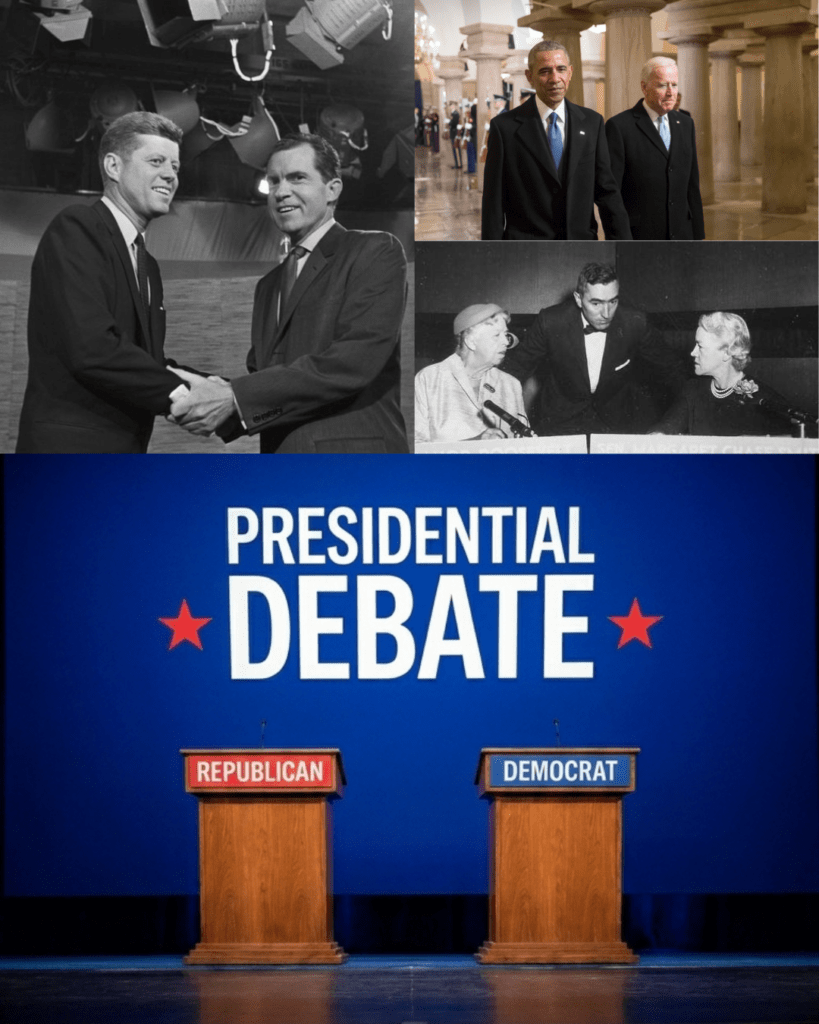
America’s democracy suffered from violence in the past, but there has been relative decorum since the introduction of televised presidential election debates in 1956. The first presidential election debate was unique in many ways. It is the only debate that did not present the actual candidates; instead, it featured two notable American women, former First Lady Eleanor Roosevelt and Senator Margaret Chase Smith, who faced each other on behalf of their principals, Adlai Stevenson of the Democratic Party and incumbent President Dwight Eisenhower. Also, the debate was the shortest ever recorded; it lasted for only about 27 minutes, less than one-third of the time for subsequent debates. Furthermore, this debate was featured in the slot of a popular, current affairs program: “Face of the Nation” on CBS television with limited reach and viewers. Subsequent presidential election debates were broadcast simultaneously by “television and radio stations of the United States and their affiliated stations,” guaranteeing wider reach, more viewers and listeners.
The presidential election debates also showed the slow and hesitant progress made by American society on societal issues such as marginalization of women and African-Americans. For a long time, these groups lived on the fringes of America’s society. They were not allowed to vote for a considerable period. White American women were allowed to vote across all states in America for the first time in 1920 after the 19th Amendment, 96 years after the popular vote was introduced to America’s democracy in 1824. The bill for the 19th Amendment took over four decades before it was passed into law, after its introduction to Congress in 1878. The last obstacles to voting rights for minority groups were dismantled in 1965 following an amendment to the Voting Rights Act. The first “real” televised presidential debate in America happened in 1960 between Vice-President Richard Nixon and Democrat Senator John F. Kennedy. Across four debates, beginning on September 26, 1960, and ending on October 21, 1960, these debates utilised 20 white male journalists selected from different media platforms. Also, the first televised presidential debate in 1956 had no place for either an American female journalist nor African-American journalist.
On September 23, 1976, Elizabeth Drew of The New Yorker Magazine became the first woman to appear among the panel of journalists in a presidential debate. It was during the first presidential debate between President Ford and Governor Jimmy Carter. The other participants were white male journalists. There was no place for an African-American journalist. It was also the first debate to feature an incumbent president and the first in the series of debates sponsored by the League of Women Voters Education Fund. The second debate on October 6, 1976, was the first time a white female journalist, Pauline Frederick, moderated a presidential election debate. All three panelists for this debate were white male journalists. The third debate on October 22, 1976, was also moderated by a white woman, Barbara Walters. This debate was unique for two reasons: It took place on the campus of the College of William and Mary to honour five students of the college who, in 1776, the year of America’s independence, formed Phi Beta Kappa, a sociopolitical group which met regularly to debate “without reserve” the issues of the day and “dispel the clouds of falsehood.” Also, it was the first debate that featured an African-American journalist, Robert Maynard.
The reluctance to include female journalists and African-Americans in these debates mirrors the habitual patriarchal white dominance of American society and the repression of women and people of colour, which has continued to plague American society. For instance, for a very long time, it was not mandatory for women in America to be included in jury duties, even in the trial of cases involving women. The sad case of Gwendolyn Hoyt in 1957 brought this aspect of repression of women’s rights to the fore. The ruling of the Supreme Court of Florida and the US Supreme Court against Hoyt after she appealed the verdict of an all-male jury, and the long years it took for this injustice to be addressed, point to the entrenched and institutionalised nature of the discrimination against women. The apex court judgment reads in part: “Despite the enlightened emancipation of women, they occupied a unique position as the center of home and family life.” Those words summarized the dominant view held by many American men for a long time.
Also, it is pertinent to consider how much the strong, aggressive performance of Senator John F. Kennedy during four rounds of debates contributed to his triumph at the polls. He was the first presidential candidate of Catholic faith to be elected President of the US. Like American women and African-Americans, American Catholics were discriminated against since the time of the Founders. In infant America, Catholics were a minority, accounting for less than 2% of the nearly four million Americans recorded in the 1790 census. American Catholics suffered discrimination for a very long time. Only two presidential candidates of the Catholic faith have been elected President of the US. President Joe Biden is the second candidate to be so elected. In the build-up to the 1960 election, John Kennedy was interrogated ceaselessly about his Catholic faith and his political independence, to the extent that he spent considerable campaign time stating his position and pledged to step down if ever the duties of the presidency required that he befouled his conscience or the interest of the US. Vice-President Richard Nixon, his opponent, who was of the Quaker faith, was not subjected to the same demands. Alfred Smith, the first presidential candidate of Catholic faith, was not so fortunate. He was nominated by the Democratic Party and was attacked ceaselessly by the Ku Klux Klan and other groups for his rigid stand on Prohibition, women’s suffrage, and his Catholic faith. He lost to Herbert Hoover by a wide margin. Senator John Kerry is another unsuccessful presidential candidate of Catholic faith.
Two Independent Party candidates were involved in televised presidential election debates during this period; Congressman John Anderson against Governor Ronald Reagan on September 21, 1980. President Jimmy Carter refused to participate. President Carter would later engage Reagan in a televised debate on October 28, 1980. The debate was the last nail in President Carter’s reelection bid as Reagan used all of his charm and skill as a successful actor to his advantage. In 1992, businessman Ross Perot, an Independent Party candidate, took part in three rounds of debate with Governor Bill Clinton and President George H.W. Bush.
The 1988 presidential election also featured a few novelties. Democratic Party nominee Michael Dukakis became the first Greek-American to be given the presidential ticket of a major political party. Also, on October 13, 1988, Bernard Shaw of CNN became the first African-American to moderate a presidential debate. The panelists for that round of debates were three women, another novelty. On October 15, 1992, Carole Simpson, an African-American female journalist, moderated the first “town hall meeting” debate. However, the most remarkable event of this era was the election of Senator Barack Obama, an African-American, as President of the US in 2008. Obama’s strong performances in three rounds of debates against Vietnam War hero Senator John McCain were confirmed by several research institutions.
The Present
The Commission on Presidential Debates took over sponsorship of presidential election debates in 1988 and continued until 2020. Two rounds of debates in 2024 were sponsored by CNN and ABC News, a departure from the past, when non-profit organizations organised the debates. Also, the structure and ambience of the debates changed over time. The recent debates were not as rigorous as those in the past, especially the debates of 1960; and the absence of an audience in the 2024 debates presents a less natural ambience. More worrisome is the absence of comradeship and warmth among the candidates, which was present in past elections but missing after the first debate of 2016.
The Future
Great Britain, the country of colonialists, monarchs, and queens, has produced three female prime ministers. However, the US, the famed champion of freedom, equality, and democracy, has not found one of its daughters worthy enough to lead the “most powerful nation in the world.” Americans will go to the polls again on November 7, 2028, to elect a new president. Whether a woman would be the presidential nominee of either of the major political parties depends on so many factors. If history serves us well, the Democratic Party will be the party to produce the first female president of the US. This will depend on the mood of the nation, the performance of Trump, and the character, charisma, and combativeness of the female presidential candidate.