Abstract
Norway has carved a niche for itself as a superpower in humanitarian and peacebuilding initiatives. For nearly a century, this has become Norway’s greatest soft power asset, and it has enabled the Nordic country to rub shoulders with traditional hard power states and global hegemons like the United States (US), China, and Russia. The Scandinavian country also has a long-standing relationship with the US, and the collective security provided by the US-led North Atlantic Treaty Organization (NATO) allows Oslo to focus on peacebuilding initiatives around the world. However, like many American allies, Norway’s relationship with the US has endured some turbulence since the return of President Trump to the White House. Trump’s preference for unpredictability, unilateralism, and bilateral relations has pitched his administration against Norway’s multilateral public diplomacy. The Nobel Peace Prize, Greenland and Norway’s Sovereign Wealth Fund have all been sources of contention between Washington and Oslo. For a small country, Norway has weathered the diplomatic storm admirably, and its giant sovereign wealth fund may yet be its biggest joker when everything else fails to appease Trump.
Key words: Soft power, Trumpian unilateralism, humanitarian initiatives.
Introduction
Peacebuilding and humanitarian initiatives are Norway’s greatest soft power assets. Norway is a country of less than six million people and has a land area of about 365,268 km². Put in perspective, Norway is about 30 times smaller than the United States (US) with a land area of about 9,833,517 km² and the US with a population of more than 300 million people is more than 56 times bigger than Norway. In fact, there are nearly as many Americans of Norwegian origin (4.6 million) living in the US as there are Norwegians living in Norway, yet Norway rubs shoulder with the US in peace keeping and humanitarian initiatives around the world (Index Mundi, 2021).
In order to make up for its relative small size Norway knew very early in its nationhood that it has to chart its own unique path of public diplomacy if it is to be relevant in a world dominated by countries with large armies and tanks. After independence from Sweden in 1905, one of Norway’s beloved founders Fridtjof Nansen, a man of uncommon courage and compassion, placed the Nordic country firmly at the center of global humanitarian leadership.
At a time when the concept of Joseph Nye’s soft power was unknown to the world, Nansen projected Norway’s soft power through his exceptional humanitarian effort as the League of Nations’ first High Commissioner in charge of refugees in 1920. In the following decade from 1920 to 1930, Nansen devoted his life to helping refugees, victims of World War I (WWI), the Russian Civil War, the Greece – Turkish War, and the Armenian Genocide, to be settled in their host countries, to find employment and attain legal status through an internationally recognized document called the “Nansen Passport,” (Sverdrup, 2026). When the cash-strapped League of Nations turned down his request for financial support with regards to relief for victims of famine in Russia, Nansen used his personal credibility and charisma to get the required fund from private organizations and the public. Unsurprisingly, when Nansen was awarded the Nobel Prize for Peace in 1922, he dedicated the prize money to promoting international relief work. In Nansen’s honor, the League of Nations renamed its High Commission for Refugees as the Nansen International Office for Refugees (Sverdrup, 2026).
This is the foundation of Norway’s rich heritage in global peacebuilding and peacekeeping initiatives. Subsequent generations of Norwegians have worked assiduously to entrench Norway’s image as a global super power in humanitarian assistance and peacebuilding initiatives. Johan Galtung, another remarkable Norwegian, who was born in the same year Nansen died, was barely six years when Nazi Germany occupied Norway in World War II (WWII), and in later years after the war, he used his lived experience of the barbarities of war as motivation to commit his entire adulthood, spanning more than six decades, to promoting peacebuilding initiatives around the world (Vision of Humanity, 2024).
At the age of 29, Galtung founded the Peace Research Institute (PRIO) in Oslo. PRIO is arguably the first institution in the world that is entirely dedicated to research and study of peace (Johansen, 2009). The man widely regarded as the father of peace studies and winner of the Right Livelihood Award, introduced the concept of Conflict Triangle as a tool for analyzing conflicts. He also put forward the concept of Positive and Negative Peace (Sverdrup, 2026). Positive peace includes both the absence of war and the presence of social justice, while negative peace is similar to what President Woodrow Wilson in his Peace Without Victory speech to the Senate, described as “peace forced upon the loser, a victor’s term imposed upon the vanquished,” (The Guardian, 2008, para 5; Vision of Humanity, 2024).
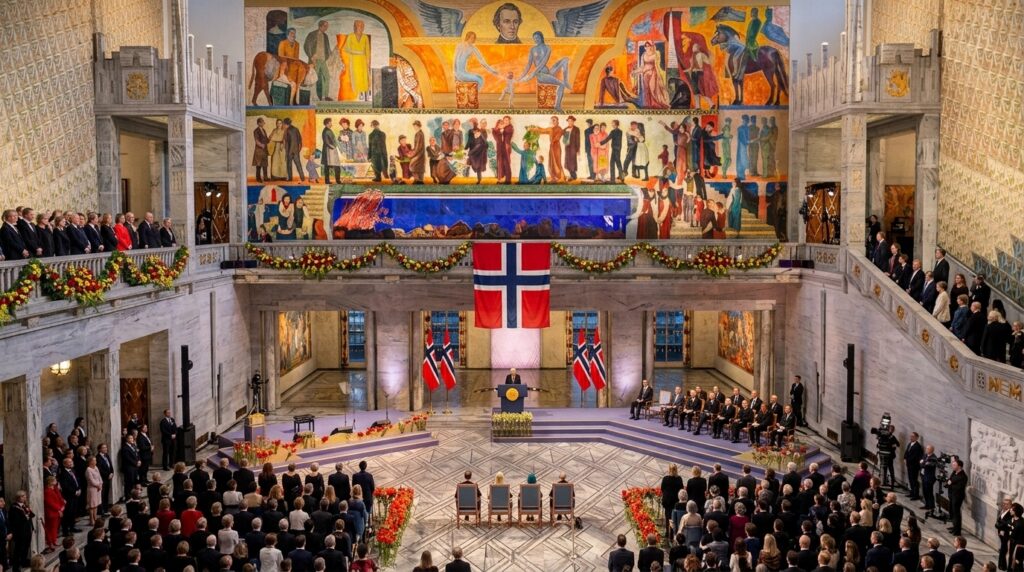
As Switzerland is the capital state for international diplomacy so is Norway the capital for global peacebuilding and humanitarian initiatives. Consequently, Oslo is home to several international institutions for peace including the Norwegian Nobel Institute which was established in 1904 and supports the Norwegian Nobel Committee in bestowing the annual Nobel Peace Prize to deserving winners.
Norway’s Recent Contributions to Peacebuilding and Global Security
The now defunct landmark Oslo Accords between Palestine and Israel may be the crowning glory of Norway’s peacemaking diplomacy, yet, the Scandinavian country’s humanitarian footprints transcend the entire globe. Afghanistan, Columbia, Philippines, Guatemala, Yemen, Nepal, Somalia, Sri Lanka, South Sudan, and Sudan are just a few on the nearly inexhaustible list. Even poorer European countries benefit from Norway’s generosity and desire for a more peaceful and socioeconomically balanced world through the European Economic Area (EEA), and Norway Grants (EFSA, 2026; Government of Norway, 2025).
Since 1990, Norway has been in the forefront of peacebuilding efforts, when at the invitation of Norwegian civil societies, the Norwegian government took up an active role in the Guatemalan peace process. Between 1990 -1994, the Scandinavian country applied its famed “two track” diplomacy to the Guatemalan conflict, combining both state-level, official diplomacy with unofficial, civil society-driven interventions. Later, in 1994, Norway, along with Mexico, Spain, Colombia, US and Venezuela formed the ‘Group of Friends’ that signed the Guatemalan peace accord in 1996 (Salvesen, 2002). Afterwards, Norway collaborated with the United Nations (UN) and Non-Governmental Organizations (NGOs) such as the Norwegian Red Cross and the Norwegian Church Aid to ensure execution of the terms of the peace agreement (Egeland, 1998).
Although the Anti-Personnel Mine Ban Convention is better known as the Ottawa (Canada) Convention, however, it is important to note that the treaty was formally adopted in Oslo in 1997 as an expression of Norwegian government’s central position in the campaign after it worked closely with NGOs like the International Campaign to Ban Landmines (ICBL) and the Norwegian People’s Aid (Government of Norway, 2026). In 2025, five European countries withdrew from the Ottawa Convention because of the threat from Russia’s invasion of Ukraine, however, Norway, in contrast, renewed its commitment and criticized fellow Nordic country Finland for pulling out of the ICBL (Giordano, 2025; Human Rights Watch, 2025).
Furthermore, Norway’s ministry of foreign affairs for nearly four decades has supported the efforts of its former Vice-Minister Jan Egeland to limit the proliferation of small arms, especially in regions prone to conflict (Egeland, 1998; The New Humanitarian, 2006). In the intervening years, Norwegian government and NGOs have collaborated with the UN agencies like the United Nations Institute for Disarmament Research (UNIDIR), and regional groups like African Union’s Silencing the Guns to promote the ideals of limiting trafficking and diversification of Small Arms and Light Weapons (SALW); Weapons and Ammunition Management (WAM); and adherence to Arms Trade Treaty (ATT) (Egeland, 1998; Norway in the UN, 2021).
Peacebuilding and Humanitarian Initiatives as Norway’s Soft Power Capital
Power is an essential and indispensable ingredient of international relations between states. In international politics, power determines who gets what, when, where and how (Lasswell, 1936). Expanding on the concept of power in international politics and relations among states, Nye (2008) defines power as the ability to influence others in order to obtain desired outcomes and proceeds further to identify three types of power through which one state or a group of states may influence another state or group of states to produce desired outcomes. The three types of power according to Nye (2008) are hard power, soft power and smart power (the combination of hard and soft power). Hard power is traditional power and relies on coercion through brute force or sanctions to compel obedience. The use of hard power by regional hegemons, with great economic and military might, was common in Europe and other parts of the world before the Peace of Westphalia introduced the concept of statehood, sovereignty and international law (Carvalho, 2020). The world suffered a relapse to the widespread use of hard power in the 20th century and this led to two world wars (1914 – 1918 & 1939 – 1945) that brought Europe on its knees. Afterwards, the US and its allies decided to introduce the concept of collective security through the establishment of the UN and the UN Security Council (UNSC) in 1945.
Driven by fear of domination, mutual suspicion and the desire to balance power and threat, the newly formed UN and UNSC was ideologically divided into two camps of capitalist West led by the US and socialist East led by the now defunct Union of Socialist Soviet Republics (USSR). In the ensuing bipolar world order of the Cold War era (1945 – 1991), the great power states contested for influence through both coercion and attraction (Britannica Editors, 2026). The ability to attract and influence other states through conduct and culture is what Nye (2008) refers to as soft power. One of the ingredients of soft power is credibility – the inherent attribute that other states can trust that the concerned state would deliver on its promise. Influence through soft power is also less costly and more sustainable than hard power.
The promotion of liberal democracy and multilateral institutions in the US-led Western hemisphere allowed smaller state like Norway to take advantage of collective security provided by institutions like the North Atlantic Treaty Organization (NATO) and carve out a niche for itself by taking the lead in humanitarian initiatives. Jan Egeland, who also functioned as Head of UN Humanitarian and Relief Efforts said Norway took advantage of the relative peace experienced at the end of the Cold War, its considerable economic might and its robust NGOs and research institutes to consolidate its reputation as a responsible, non-threatening, reliable and peace-loving state. Carmen Wunderlich, of the Peace Research Institute Frankfurt (PRIF), underlined the point about Norway’s small-state stature and its big-state soft power credential: “I think small states can have considerable influence through soft power, for example, by being a critical voice or by providing expertise and information,” (Perelstein, 2009, para 14).
Norway provides more than “expertise and information,” the Nordic country contributes 1% of its Gross National Income (GNI), about $5.7 billion annually, to global support of UN Sustainable Development Goals (SDGs). This value is more than the UN’s 0.7% benchmark for Official Development Assistance (ODA) and places Norway among the most generous member of the Development Assistance Committee (DAC), (OECD, 2026). Norway’s contribution to global SDGs and humanitarian initiatives have been consistent over the decades. In 2008, the Scandinavian country’s expenditure on foreign aid was about $4 billion, representing about 1% of Norway’s Gross Domestic Product (GDP) and according to report by Norwegian Agency for Development Cooperation (NORAD), the sum was disbursed to support 110 countries (Perelstein, 2009).
Norway’s generous and responsible international citizen image is not only projected abroad but also at home, ensuring that the country is consistently regarded globally as one of the best countries in the world to reside. A UN survey in 2009 ranked Norway as the best country in the world to live. The parameters used by the survey were: Life expectancy, access to healthcare, safety, literacy, personal freedom, education and GDP per capita, (Perelstein, 2009). Similarly, a recent survey by US News using the same parameters ranked Norway third after fellow Nordic countries, Finland and Iceland (Binder, 2026).
Norway’s image as a peaceful country and a peacemaker, enables the Nordic country to serve as a facilitator for global peace, usually at the invitation of warring parties who trust in Norway’s impartiality and experience in peace negotiations. Anniken Huitfeldt, former Foreign Affairs Minister (2021 – 2023) and current Ambassador to the US reiterates this view: “We don’t travel the world looking for conflicts or pressurizing parties [to negotiate], but when we are approached, and we see that we are able, we share the facilitation knowledge we have acquired,” (Lafuente, 2023, para 7).
Indeed, unlike great power states, Norway has no large army to compel compliance from parties in conflict. Also, unlike global hegemons, Norway does not have vast economic interests and networks to use as leverage in conflict resolution. Yet, for parties in conflict, these seeming deficiencies merely increase Norway’s altruistic value and credibility as neutral arbitrator for peace.
Trump’s Unilateralism and its Challenges to Norway’s Soft Power
Norway forged a close relationship with “big brother” America many decades before its entry into the community of sovereign states. In the 19th century when Norwegians suffered from religious persecution (Quakers and Haugean), famine (1866) and agricultural land use transformation, many Norwegians migrated to America in search of better life, especially after President Abraham Lincoln’s administration passed the Homestead Act in 1862 that made available acres of land to “citizens and future citizens’ who had never taken up arms against the US government (Ensign, 2025; NAHA, 2026). In the space of a century (1825 – 1925), about 800,000 Norwegians were reported to have migrated to the US. The figure represents about one-third of the population of Norway at the time (Ensign, 2025).
Unsurprisingly, when Norway gained independence on June 7, 1905, it established its first embassy in Washington few months later on October 31, 1905 (Norway in the United States, 2026). Decades later, both countries fought side by side during WW II, and were co-founding nations of both the UN and NATO. Also, Norway has consistently been increasing its defense spending in line with President Trump’s demand for NATO members to shoulder more responsibility for their defense. In 2024, Norway increased its defense spending from 1.4% in 2022 to 2.2% of its GDP and the Nordic country currently stands as the only European country that can meet NATO’s 2030 benchmark of 5% GDP spending on defense without borrowing (Fouche and Carlsson, 2025).
Notably, US longest serving President Franklin Roosevelt was a personal friend of the Norwegian royal family, Prince Harald and Princess Martha and on September 16, 1942 he gave a moving speech titled “Look to Norway,” to underline the reasons and values that motivated the US to become involved in the war. ((National Archives, 2021). Furthermore, notable US presidents such as J.F Kennedy, George W. Bush, Bill Clinton, and Barack Obama also forged close relationship with Norway (The American Presidency Project, 1999).
However, since President Trump returned to the White House relationship between the once kindred nations has been fraught with tension and threats. The reasons for the cold relationship are many. Trump craves the Nobel Peace Prize, and he believes the Norwegian government, led by Prime Minister Jonas Gahr Store has an influence on the selection process. When the Nobel Committee bypassed Trump in 2025, the US President dispatched a letter stating his displeasure to his Norwegian counterpart. The letter also conveyed Trump’s veiled threat: “I no longer feel an obligation to think of peace,” (Doucet, 2026). Trump’s threat to annex Greenland has also pitched Norway against the US. Although Norway is not a member of the European Union (EU), however, the Scandinavian country is connected to the EU through treaties such as the EEA and the Schengen Agreement. Also, Oslo made the bold decision to stand with Greenland and Denmark (International Politics, 2026). Norway is also rich in critical minerals desired by the US but rather than move closer to Washington, Oslo moved to become part of the EU’s Critical Raw Minerals Legislation Act (CRMA), making Norway’s prized assets accessible to the EU (Ellingsen and Haug, 2026).
Trump favors bilateral relations and he has reacted strongly to Norway’s preference for multilateralism through the EU. Recently, when King Harald was buried, the US dispatched Under Secretary of State for Political Affairs, Allison Hooker. Washington’s low-level representation is a veiled insult and stands in sharp contrast to America’s high-level representation in 1991 when Vice-President Dan Quayle represented the US at the burial of King Olav V (International Politics, 2026).
Trump’s anger towards Norway’s goes beyond concern for diplomatic etiquettes. In July 2026, Trump’s administration, citing irregularities in Oslo’s supply chain, including alleged use of forced labor, slapped additional 12.5% tariff on goods from Norway. Espen Barth Eide, Norway’s Foreign Minister after a meeting with other Norwegian ministers and local business organizations, said: “This affects businesses, and especially the seafood industry. Companies that have specialized in the US market will be affected, even if the rest of the Norwegian economy performs well,” (Furuset and Aanerud, 2026, para 3).
Norway’s $2.3 trillion sovereign wealth fund has also been trapped in Trump’s political quagmire. The fund’s Council on Ethics after careful consideration, decided to sell its stakes, worth about $1 trillion in Caterpillar, the giant American construction firm. The decision was based on Caterpillar’s role as supplier of equipment to Israel in the war against Palestinians (Reuters, 2025). In an ideal political climate, Norway’s institutions have the legitimate right to make such decisions in line with the values of the state. However, in the new Trumpian political climate where hard power is wielded over allies with relish, even such sovereign decisions that goes against perceived American interest are challenged. A US State Department spokesperson said Norway’s decision was based on “illegitimate claims against Caterpillar and the Israeli government” (Reuters, 2025). Late Republican Senator Lindsey Graham who had the ears of President Trump advised the American government to impose tariffs and visa revocations as retribution. In a related development, Trump’s administration also accused Norway of currency manipulation through channeling earnings from oil into foreign currencies using state controlled institutions (International Politics, 2026).
How Norway can Navigate Trump’s Unilateralism
The winner of Nobel Prize 2026 will be announced on October 9, 2026 and should the Norwegian Nobel Committee decide to grant Trump his much coveted laurel, it may help diffuse tensions between both countries. The US Mid-term election billed for November also offers another opportunity to put the brakes on hostilities if the Democratic Party achieves majority status in Congress. Meanwhile, in May and August 2026, Norway joined US-led Pax Silica and Forum on Resource Geostrategic Engagement (FORGE) initiatives that were established to help US and its allies, access and manage critical minerals required for AI technology and reduce reliance on China (Reuters, 2026).
Conclusion
Trump is as unpredictable as the weather in spring. In January 2026, he threatened to impose tariffs on eight European countries because of their commitment to defending Greenland (Abc News, 2026). A few days later, the US president walked back on his threat claiming “a framework of a future deal” for Greenland has been agreed upon (Dorn, 2026). Like most US allies, Norway’s national interest is best served managing relations with US using conciliation and standing firm when red lines are approached. Above all, Norway still has one trump card, the largest sovereign wealth fund in the world, 50% of which is invested in the US. Money talks and no one understands that better than Trump.
References
Abc News. (2026). Donald Trump announces tariffs for eight countries as Greenland stand-off continues. Abc News. Donald Trump announces tariffs for eight countries as Greenland stand-off continues – ABC News
American Presidency Project. (1999). Remarks at a Luncheon Hosted by King Harald V of Norway in Oslo. American Presidency Project. Remarks at a Luncheon Hosted by King Harald V of Norway in Oslo | The American Presidency Project
Binder, M. (2026). The 7 Highest-Ranking Countries for Quality of Life This Year. Yahoo Life. The 7 Highest-Ranking Countries for Quality of Life This Year
Britannica Editors. (2026). Cold War: International Politics. Britannica. Cold War | Dates, Definition, Timeline, Summary, Era, & Facts | Britannica
Carvalho, B.L. P.de. (2020). The Peace of Westphalia: A landmark for International Relations. Café História. https://www.cafehistoria.combr/westphalia-peace-landmark/
Dorn, S. (2026). Trump Says Agreement Reached On Greenland – Cancels New Tariffs On Europe. Forbes. Trump Cancels 10% Tariffs On NATO Countries Defending Greenland
Doucet, L. (2026). Lyse Doucet: Trump is shaking the world order more than any president since WW2. BBC. Lyse Doucet: Trump is shaking the world order more than any president since WW2
Egeland, J. (1998). Peacemaking and the Prevention of Violence in Situations of Internal Strife and Intra-State Conflict: The Role of Governments and NGOs. IDB-Seminar in Cartagena.
EFSA. (2026). EEA Grants and Norway Grants. European Food Safety Authority. EEA Grants and Norway Grants | EFSA
Ellingsen, O. C., & Haug, L. (2026). New Minerals Act adopted and draft regulation sent for consultation. Thommessen. New Minerals Act adopted and draft regulation sent for consultation | Advokatfirmaet Thommessen
Ensign, A. (2025). Norwegian Immigration: Discover Norwegian American History. Family Search. Discover Your Norwegian Immigration Roots
Fouche, G., & Carlsson, I. (2025). Norway to meet 5% NATO goal on defence, security spending, prime minister says. Reuters. Norway to meet 5% NATO goal on defence, security spending, prime minister says | Reuters
Furuset, A., & Aanerud, O. (2026). Norway business leaders and government meet about Trump’s tariffs. IntraFish, para 3. Norway business leaders and government meet about Trump’s tariffs
Giordano, E. (2025). Norway criticizes Finland’s move to quit land mine treaty. Politico. Norway criticizes Finland’s move to quit land mine treaty – POLITICO
Government of Norway. (2025). Norway’s Engagement in Peace Processes Since 1993. Ministry of Foreign Affairs. Norway’s engagement in peace processes since 1993 – regjeringen.no
Government of Norway. (2026). Norway Strengthens Efforts Against Landmines and Explosives Globally. Norway in Geneva. Norway Strengthens Efforts Against Landmines and Explosives Globally (06.08.2026) – Norway in Geneva
Human Rights Watch. (2026). Five European States Withdraw from Mine an Treaty. Human Rights Watch. Five European States Withdraw from Mine Ban Treaty | Human Rights Watch
Index Mundi. (2021). Norway vs. United States. Index Mundi. Norway vs. United States – Country Comparison
International Politics. (2026). Ice-cold relations between the US and Norway. Society and Politics. Tense Between Norway and the US: Tariffs and a Military Foothold
Johansen, J. (2009). International Peace Research Institute. The Oxford International Encyclopedia of peace. International Peace Research Institute |
Lafuente, J. (2023). Norway and the Diplomacy of Peace. El Pais 50, para 7. Norway and the diplomacy of peace | International | EL PAÍS English
Lasswell, H.D. (1936). Politics: Who Gets What, When, How. Whittlesey House (McGraw-Hill). Politics who gets what, when, how : Harold D. Lasswell : Free Download, Borrow, and Streaming : Internet Archive
NAHA. (2026). The Great Setting. Norwegian American Historical Association. The Great Settling – NAHA
National Archives. (2021). Look to Norway. Franklin D. Roosevelt Presidential Library and Museum. Look to Norway – Forward with Roosevelt
Norway in the UN. (2021). SC: Small Arms. Permanent Mission to the United Nations in New York. SC: Small arms – Norway in the UN
Norway in the United States. (2026). About the Embassy in Washington, D.C. Norway in the United States. About the Embassy in Washington, D.C. – Norway in the United States
Nye, J.S. (2008). Public diplomacy and soft power. The Annals of the American Academy of Political and Social Science, 616(1), 94-109.
Perelstein, J.S. (2009). Norway leads on soft power diplomacy. Dagens Perspektiv, para 14. Norway leads on soft power diplomacy
Reuters. (2025). Trump administration ‘troubled’ by Norway wealth fund’s divestment from Caterpillar. Construction Briefing. Trump administration ‘troubled’ by Norway wealth fund’s divestment from Caterpillar – Construction Briefing
Reuters. (2025). Norway says it seeks to keep large US investments despite Caterpillar brawl. Yahoo Finance. Norway says it seeks to keep large US investments despite Caterpillar brawl
Reuters. (2026). Norway joins US-led effort to secure AI supply chains. Reuters. Norway joins US-led effort to secure AI supply chains | Reuters
Salvesen, H. (2002). Guatemala: Five Years After the Peace Accords. International Peace Research Institute, Oslo. Guatemala: Five Years After the Peace Accords
Sverdrup, H.U. (2026). Statesman and Humanitarian. Britannica. Fridtjof Nansen – Polar Explorer, Nobel Laureate, Humanitarian | Britannica
The Guardian. (2008). We need a peace without victory: Woodrow Wilson’s Senate address, 2017. The Guardian, para 5. ‘We need a peace without victory’ | First world war | The Guardian
The New Humanitarian. (2006). UN humanitarian chief Egeland leaving post at the end of the year. The New Humanitarian. UN humanitarian chief Egeland leaving post at end of year
Vision of Humanity. (2024). Johan Galtung, 1930 – 2024: A Life Dedicated to Peace. Vision of Humanity. Johan Galtung, 1930 – 2024: A Life Dedicated to Peace