Autocracy and democracy are fighting for the soul of our world. Putin riding roughshod over Russia, the
largest country in the world, a sixth of our world with enormous military and natural resources, is threatening
Armageddon if he is not allowed to keep his illegally acquired territories in Ukraine. Should the United States
and its allies succumb to Putin’s threat of nuclear warfare and negotiate with Kremlin?
Putin is desperate for allies as he attempts to become a revisionist power. China, the second most populous
country in the world and rising world power is a close ally. North Korea and Iran are also allies of Putin.
These countries have one thing in common, autocratic leaders with utter disdain for human rights. But will
Pyongyang, Beijing and Tehran back Putin if he makes good his threat of nuclear warfare?
Events on the battlefields point to victory for Ukraine and humiliating defeat for Putin and Russia. Experts
are of the opinion that the war will only end if the US and its allies abandon Ukraine or if Putin suffers
debilitating defeat. The latter is more likely to happen. The US and its allies are determined to support Ukraine
through the war. What is at stake is more than resource control, it is a battle between autocracy and
democracy, between hard power and soft power, between subjugation and liberty, between fear and freedom,
between coercion and cooperation. In this battle, no country can be neutral.
In April, nearly two months after Putin launched what he deceptively called “Special Military Operation” in
Ukraine that has claimed hundreds of thousands of lives, including children, one month after the horrors of
Bucha, 193 countries on the floor of the United Nations General Assembly voted on a resolution to suspend
Russia from the UN Human Rights Council. 93 countries voted in favour of the resolution, 24 voted against
and 58 abstained from voting. The resolution went through having attained the two-third majority threshold.
Russia decided to quit the council.
It is instructive to take a close look at the voting pattern. Members of the BRICS, Brazil, Russia, India, China
and South-Africa, emerging economic and military power group, voted against or abstained from voting.
Members of regional group, Shanghai Cooperative Organization where Russia and China hold sway voted
largely against.
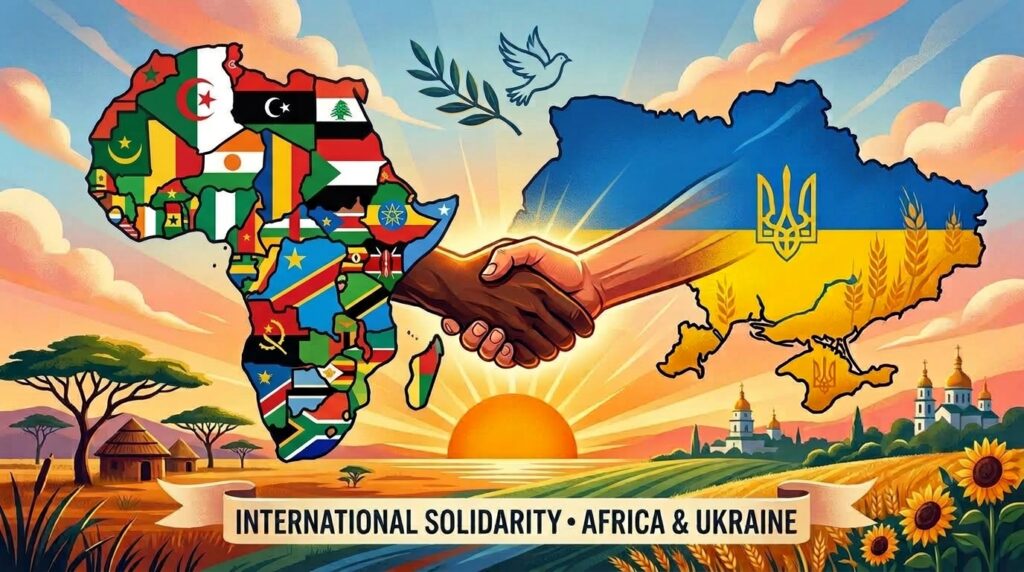
Grains and oil from Ukraine feed many African countries, Russia’s Black Sea blockade has caused acute food
shortage affecting millions of Africans, so how did African countries vote? Out 54 African countries, only
Chad, Cote d’Ivoire, Libya, Liberia, Malawi and Sierra Leone voted for the resolution. 48 African countries
voted against or abstained from voting. Even stable democracies, Ghana and Kenya, Nigeria and Senegal
abstained from voting. A significant feature is that African countries under autocratic leaders, Rwanda, Mali,
Zimbabwe, Gabon, Congo, Burundi, all voted against the resolution. What is responsible for this cold shoulder
from African leaders on a global humanitarian crisis?
For several decades, Russia succeeded in presenting itself as a viable, friendly partner for many African
countries, a less demanding and amenable partner, more desirable than the nitpicking, meddlesome colonialists
in France, Great Britain or America. Freedom fighters in Zimbabwe (then Southern –Rhodesia) point to the
support they received from Russia (then part of the defunct USSR) in their struggle for independence from
Britain. Mali, Central African Republic, Burkina Faso are locked in a deadly romance with Wagner Group, a
shadowy mercenary organization founded by Yevgeny Prigozhin, Russian oligarch and confidant of Putin.
These mercenaries are paraded as heroes in the fight against Jihadist elements in many African countries and
even boost of a statue in CAR, but the Wagner Group have been accused of gross human rights violation,
murder of hundreds of villagers, rape, torture, wilful exploitation of natural resources and consequential
environmental degradation. Does this matter in a continent where the leaders are covered in corruption and
have no qualms in cutting shady deals with unscrupulous individuals at the detriment of their country?
Haven’t African leaders been involved in the wilful mass murder of their own citizens under one guise or the
other? Didn’t the Nigerian government murder peaceful protesters at the Lekki tollgate before the glare of the
world?
How long will African leaders choose self-interest over national-interest? How long will a few corrupt leaders
continue to define national-interest to the exclusion of others in Africa? Why should African leaders jettison
their self-interest which is well served by Russia under Putin? What does Ukraine, the United States of
America and the West have to offer Africa?
Apart from being the bread basket of the world, Ukraine is a bastion of democracy in a region where autocracy
is deeply entrenched. Kazakhstan, Azerbaijan, Belarus, Tajikistan, Turkmenistan, Kyrgyzstan and
Uzbekistan, more than 30 years after the breakup of the Soviet Union, continue to exist as states under
autocracy, and mere dirty appendages of Russia. Ukrainians fought with their blood for the democracy they
enjoy today which is a threat to Putin, what he deceptively labelled “Nazification”.
The human spirit thrives in freedom; the function of government is to ensure that one person’s liberty does not
harm another person’s freedom. Every attempt by government to shackle the human spirit will be met with
resistance, this will in turn stifle productivity and development. Many African states are in danger of
becoming failed states, flat on all Human Development Index and fertile ground for terrorist groups. Young
and best brains in Africa continue to migrate not to “friendly” Russia, but to America and the West, land of
opportunities.
African countries will do well to support Ukraine and embrace true democracy. It offers inclusive development
and peace. The LGBT has been a vexatious issue among many African states. Putin has amplified this in his
denunciation of “American imperialism”. But this is only a thin veil to cover the deep rot caused by insecurity,
human rights violations and underdevelopment in many African countries. African countries are free to retain
their uniqueness while embracing democracy. This is what Ukraine stands for, the path to peace and progress
for all citizens.
This article was written by Soni Gold in May 2022.
